Social Security Was Never Supposed to Be Your Whole Retirement Plan
Social Security was designed as insurance, not a magic money machine, and understanding that one fact clears up a lot of confusion.
Most people talk about Social Security as if it were a retirement account with your name written on it in a nice little government file cabinet somewhere.
That would be comforting.
It would also be wrong.
Social Security was not designed as a personal savings account. It was not designed as a private investment account. It was not designed as a pile of your money sitting in Washington, quietly waiting for you to turn 67 so it can be handed back with a bow on top.
That is not how the system works.
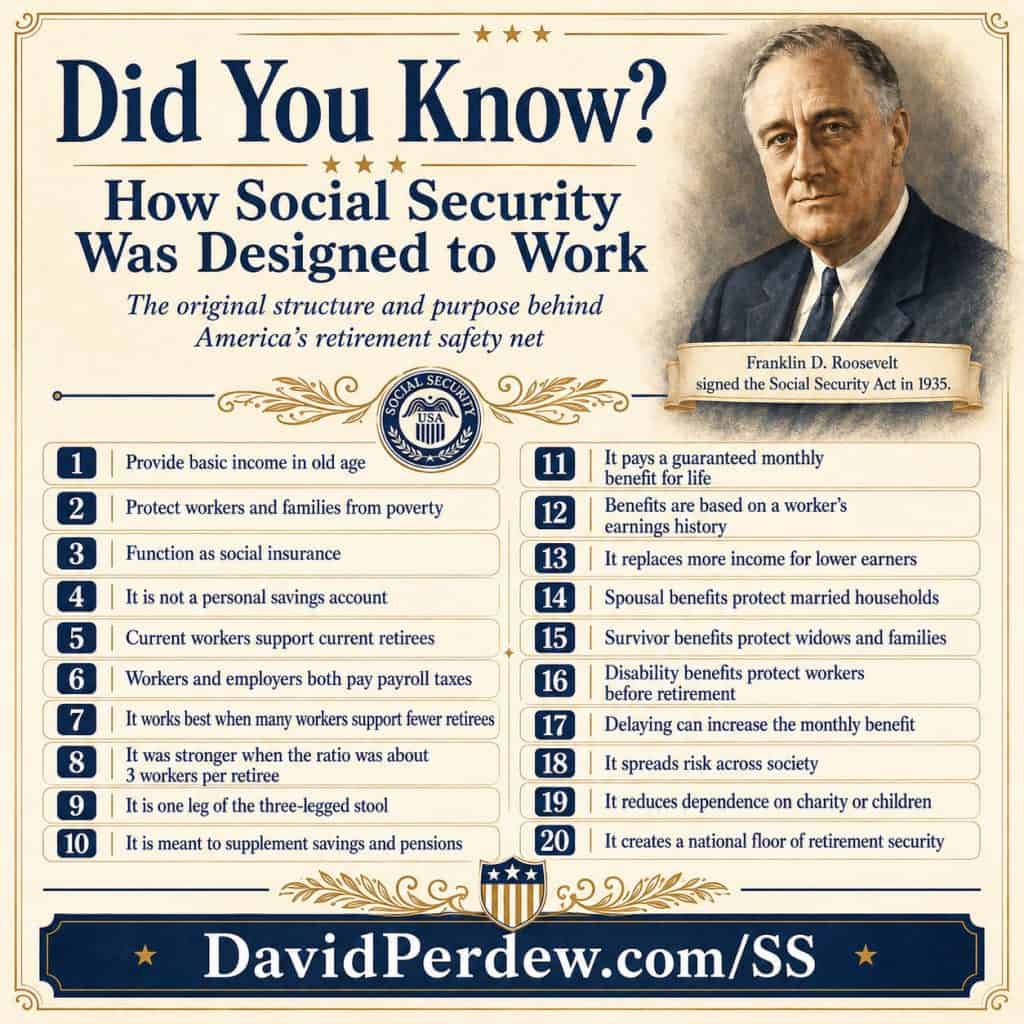
Social Security was designed as social insurance. That phrase may sound dull enough to make your eyes glaze over, but it matters. It means the system spreads risk across the population. Workers pay in. Beneficiaries receive payments. Families are protected. Retirees have a floor under them. Widows, widowers, disabled workers, spouses, and children may have protection too.
In other words, Social Security was built to keep old age, disability, and the death of a wage earner from becoming a financial catastrophe.
That is not a bad idea. In fact, it is one of the most successful anti-poverty ideas America ever created.
It Was Designed to Provide Basic Income in Old Age
Before Social Security, growing old without money was not a charming “simpler times” story.
There was no golden age where everyone sat on the porch, drank lemonade, and was lovingly cared for by three generations of family members who all lived next door.
Some families did that. Many could not.
Older people who had no savings, no pension, no land, and no family support often faced ugly choices. They moved in with relatives who were already struggling. They relied on charity. They went to poorhouses. They kept working long past the point when their bodies were begging them to stop.
Social Security was created to provide a basic income in old age. Not luxury. Not beach-house money. Not “let’s take three cruises and buy matching scooters” money.
Basic income.
A monthly check that arrives for life is powerful because it gives people something they cannot easily create on their own, predictable income they cannot outlive.
That lifetime feature is one of the most important parts of the design.
It Is Insurance, Not Savings
Here is where people get tangled up.
They say, “I paid into Social Security. I want my money back.”
That sounds reasonable, but Social Security is not set up like a bank account. It is more like insurance.
You pay homeowners insurance. You do not expect the insurance company to keep your exact premiums in a little shoebox with your name on it. If your house burns down, the insurance pays. If it does not burn down, you do not get to storm the office and demand your unused fire money.
Social Security works in a similar broad-risk way.
Current workers pay payroll taxes. Those payroll taxes help fund current beneficiaries. When today’s workers retire, the next generation of workers helps fund them.
That is the basic pay-as-you-go design.
This is also why the worker-to-beneficiary ratio matters so much. The 2024 Trustees Report showed 36 beneficiaries for every 100 covered workers in 2023, which is roughly 2.8 workers per beneficiary. The report projected that ratio would rise to 44 beneficiaries per 100 covered workers by 2040 under intermediate assumptions. Translation: fewer workers will be supporting more beneficiaries, and that makes the math tighter.
Not impossible.
Not “Social Security is gone next Tuesday.”
Just tighter.
Current Workers Support Current Retirees
This is the part that makes some people nervous.
They hear, “current workers support current retirees,” and immediately someone starts shouting that the system is a Ponzi scheme.
It is not.
A Ponzi scheme is fraud. Social Security is a public insurance program created by law, funded by payroll taxes, and reported on every year by the Trustees. You can like it, dislike it, reform it, complain about it, or write strongly worded Facebook posts about it. But calling it a Ponzi scheme is lazy thinking dressed up as cleverness.
The design is simple.
Workers and employers both pay Social Security payroll taxes. The money goes into the system. Benefits are paid to retirees, survivors, disabled workers, and eligible family members. SSA explains that benefits replace only part of your earnings and are based on how much you earned during your working career. Higher lifetime earnings generally produce higher benefits.
That is why your earnings record matters.
If you spent years underreporting income, taking too little salary from your business, or ignoring your Social Security statement, congratulations, you may have successfully saved a few dollars in taxes while quietly mugging your future self in a parking lot.
The Three-Legged Stool Was the Point
Social Security was never meant to carry the whole retirement load.
For years, retirement planners talked about the “three-legged stool.” One leg was Social Security. One leg was private pensions. One leg was personal savings and investments. SSA’s own history page describes the metaphor exactly that way and says the point was that all three approaches were needed for stable retirement income.
That image matters.
A stool with three legs can stand.
A stool with one leg is not a stool. It is a stick. Sit on it and see how that goes.
The problem is that many Americans now reach retirement with one weak leg, one missing leg, and Social Security doing the work of a full dining room chair.
Traditional pensions have declined. Personal savings are often too small. Many people are carrying debt into retirement. Medical costs are higher. Housing is expensive. Adult children may not be in a position to help.
So Social Security, which was designed as one part of the plan, becomes the plan.
That is dangerous.
Not because Social Security is worthless. Quite the opposite. It is incredibly valuable. But it was designed to supplement other income, not replace all of it.
The Formula Is Progressive, Whether People Know It or Not
Social Security benefits are based on your earnings history, but the formula is not flat.
Lower earners generally receive a higher percentage of their pre-retirement income than higher earners. That is intentional. The system was designed to provide a stronger floor for people who had lower wages during their working years.
That does not mean higher earners get nothing. They may receive larger checks in dollar terms. But lower earners often get a better replacement rate.
This is one reason Social Security has helped reduce poverty among older Americans.
It is not just a retirement program. It is a poverty-prevention program, a family-protection program, a disability-protection program, and a longevity-insurance program all rolled into one.
Try putting that on a bumper sticker.
It Protects Families, Not Just Retirees
Another misunderstood part of the design is that Social Security is not only about retirement.
Yes, retirement benefits get most of the attention. That is the big show. That is where people obsess over whether to claim at 62, full retirement age, or 70.
But the system also includes survivor benefits, spousal benefits, and disability benefits.
That means a worker’s record may protect a spouse. It may protect children. It may protect a widow or widower. It may protect a worker who becomes disabled before retirement age.
This is why treating Social Security like a simple investment account misses the point.
Your IRA does not send survivor benefits to your young children based on your earnings record. Your savings account does not automatically create disability protection. Your brokerage account does not care whether your spouse is left with enough income after you die.
Social Security was designed to cover risks that individual families often cannot handle alone.
Delaying Can Increase the Monthly Benefit
Another design feature is that claiming age matters.
You can claim retirement benefits as early as 62, but your benefit is reduced if you claim before full retirement age. If you delay beyond full retirement age, your monthly benefit can increase up to age 70.
This does not mean everyone should wait.
It does mean the system was designed to reward delayed claiming with a larger monthly check. That larger check can matter a lot later in life, especially if you live into your 80s or 90s.
People love to argue about the break-even point. Fine. Have the argument. Make a spreadsheet. Pour coffee. Use colored pens if that makes you feel alive.
But do not miss the bigger issue.
A larger monthly benefit can improve lifetime cash flow. It can protect a surviving spouse. It can reduce pressure on savings. It can make the difference between breathing room and panic in your later years.
The Real Design Goal Was Dignity
At its core, Social Security was designed to create a national floor of retirement security.
Not wealth.
Not total comfort.
Not financial perfection.
A floor.
That floor matters because without it, too many older Americans would be forced back into dependence on charity, children, poorhouses, or whatever work their aging bodies could still manage.
And let’s be honest. “My retirement plan is hoping my knees hold up while I greet people at a big-box store” is not exactly a plan that inspires confidence.
Social Security gave millions of people something more stable.
A monthly check.
A measure of independence.
A little dignity.
That is the design.
The Bottom Line
Social Security works best when we understand what it was built to do.
It was designed as social insurance. It was funded mainly through payroll taxes. It depends on workers supporting beneficiaries. It was meant to be one part of retirement income, not the whole thing. It protects workers, spouses, survivors, disabled people, and retirees.
It is not perfect. It needs attention. It faces real funding challenges.
But it is not mysterious.
And it is not going away just because somebody with a microphone, a bad chart, and a suspiciously confident voice says so.
Know the design, and you can make better decisions.
Ignore the design, and you are just guessing with your retirement income.
That is a terrible hobby.