
Social Security Questions to Ask Before You Claim
Choosing when to claim Social Security is not about copying your neighbor. It is about asking the right questions before you lock in a lifelong income decision.
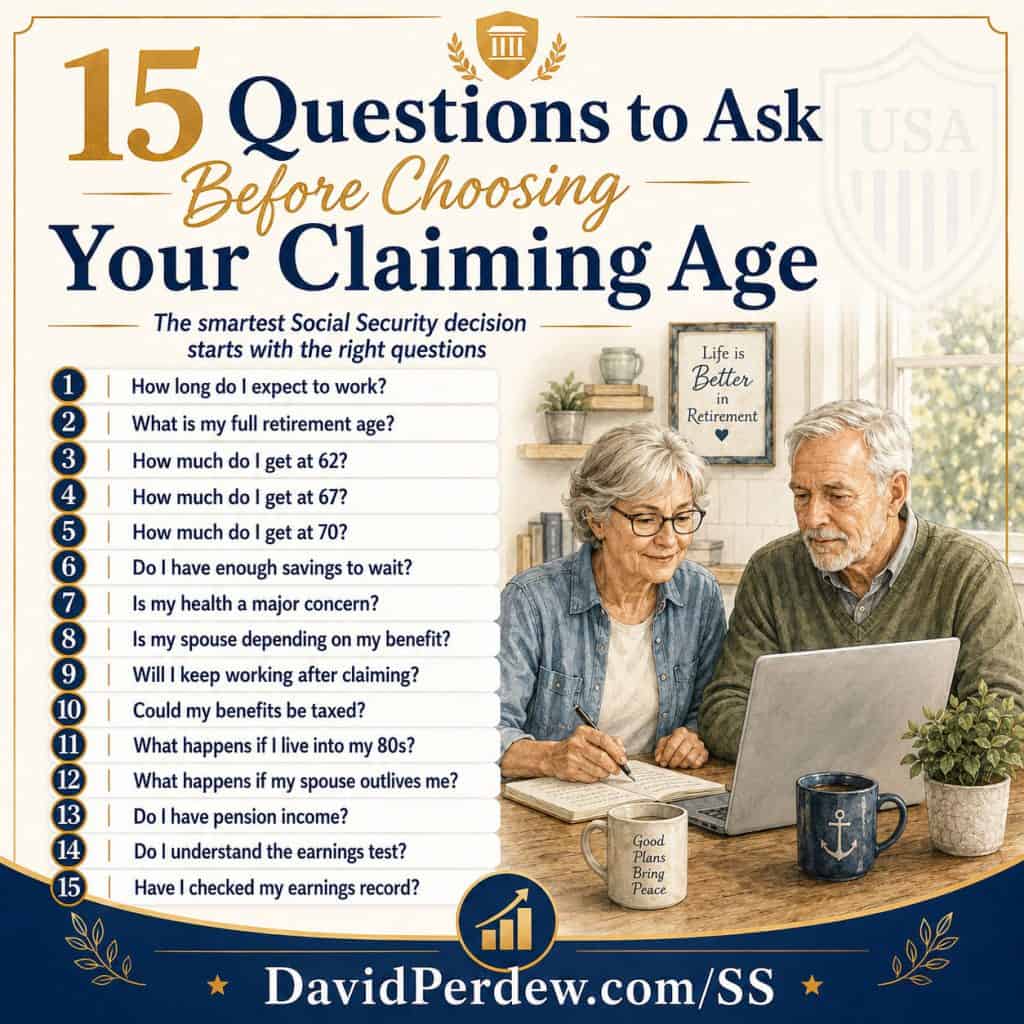
Most people spend more time shopping for a refrigerator than planning when to claim Social Security.
That sounds harsh.
It is also true.
They will compare ice makers, shelf layouts, stainless steel finishes, energy ratings, delivery fees, and whether the freezer drawer makes them feel emotionally supported.
But when it comes to Social Security, a decision that may affect income for the rest of their lives, they shrug and say, “I’ll probably take it at 62.”
Based on what?
“My friend did.”
Excellent. That is how we should make lifelong financial decisions. Next, we can choose heart surgery based on who has the best parking.
The truth is that Social Security claiming is not one decision. It is a cluster of decisions wrapped around your health, savings, spouse, work plans, taxes, longevity, and need for monthly cash flow.
So before you claim, ask better questions.
Not because questions are fun.
Because guessing is expensive.
What Is My Full Retirement Age?
Start here.
Your full retirement age is the age when you can receive your full Social Security retirement benefit without an early-claiming reduction.
For many people nearing retirement now, full retirement age is 66 and some months or 67, depending on birth year.
That number matters because claiming before full retirement age usually reduces your benefit. Waiting beyond full retirement age can increase it up to age 70.
If you do not know your full retirement age, you are making the decision in the dark.
And retirement is not the best time to play financial hide-and-seek.
How Much Do I Get at 62, Full Retirement Age, and 70?
Do not talk about claiming age in general terms.
Get your actual numbers.
How much would you receive at 62?
How much at full retirement age?
How much at 70?
Those three numbers tell a story. Sometimes the difference is modest enough that claiming earlier feels reasonable. Sometimes the difference is large enough to make you sit back and say, “Well, that changes things.”
And it often does.
A higher monthly benefit does not just matter in year one. It can matter every month for the rest of your life. It can also matter to a surviving spouse.
So before you claim, look at the actual benefit estimates.
Not vibes.
Not rumors.
Numbers.
Numbers are annoying, but at least they do not gossip.
Do I Need the Money Now?
This question is both obvious and underrated.
Some people need the money now.
Not in theory. Not because they want to remodel the kitchen. They need it for food, housing, utilities, insurance, medicine, or basic living costs.
If that is your situation, claiming earlier may make sense.
There is no shame in needing income. Retirement planning advice often sounds like it was written for people with large savings accounts and a casual relationship with reality.
But if you do not need the money immediately, pause before claiming early.
Ask whether waiting could improve your long-term security.
The fact that you can claim at 62 does not mean you should.
You can also eat gas station sushi.
Availability is not the same as wisdom.
How Long Do I Expect to Work?
If you plan to keep working, claiming early may be more complicated.
Before full retirement age, the earnings test may reduce your benefits if your wages or self-employment income exceed the annual limit.
That does not mean you can never work and claim. It means you need to understand the rule before you build a plan around money that may be temporarily withheld.
Also, working longer may improve your benefit if you replace lower-earning years in your 35-year earnings calculation.
So the question is not simply, “Can I retire?”
It is also, “What happens if I keep working?”
Work can affect cash flow, taxes, benefit estimates, Medicare decisions, savings withdrawals, and the timing of your claim.
In other words, it is connected to everything because retirement planning apparently needed more moving parts.
Is My Health a Major Factor?
Health matters.
If you have serious health problems or a shorter life expectancy, claiming earlier may be sensible. Waiting for a larger benefit only helps if you live long enough to receive it.
That is just the truth.
But many people use vague fear as a substitute for honest health planning.
They say, “I might not live long.”
Well, yes. None of us has a warranty.
But what does your actual health suggest? What about your family history? What does your doctor say? Are you dealing with a major condition, or just the normal creaks, groans, and suspicious noises that come with being over 60?
This is personal.
It is also important.
You do not have to be morbid. But you do need to be realistic.
Retirement planning requires a strange balance: you have to consider the possibility of dying early and the possibility of living a very long time.
Life is thoughtful that way.
What Happens If I Live Into My 80s or 90s?
People worry about dying too soon to enjoy delayed benefits.
Fair.
But what if the opposite happens?
What if you live to 85?
What if you live to 91?
What if your body keeps going long after your savings start clearing their throat nervously?
That is longevity risk. It is the risk of outliving your money.
Social Security helps with that because it pays for life. That lifetime income is one of its greatest strengths.
A larger benefit later in life may be very valuable if retirement lasts 25 or 30 years.
This is why the claiming decision should not be based only on the first few years. It should consider the long haul.
You are not just planning for the fun part of retirement.
You are planning for the older version of you who may need stable income, fewer surprises, and possibly a chair that helps you stand up.
Is My Spouse Depending on My Benefit?
If you are married, your claiming decision may affect more than you.
The higher earner’s benefit can become especially important because of survivor benefits. When one spouse dies, the surviving spouse may end up with the higher benefit, but the lower benefit usually disappears.
That means the household may lose one check.
The bills, being rude, do not politely drop by half.
So ask the question plainly: if I die first, what income will my spouse have?
If the answer is uncomfortable, good. Pay attention to that discomfort. It may be telling you something important.
Delaying the higher earner’s benefit can sometimes provide stronger survivor protection.
Not always.
But often enough that couples should discuss it before claiming.
Do I Have Enough Savings to Wait?
Waiting can increase your monthly benefit, but you need a bridge.
That bridge may be work income, savings, a pension, part-time consulting, rental income, or a careful withdrawal strategy.
If you do not have enough income to wait, then waiting may not be realistic.
This is where people sometimes get judgmental.
They say, “Everyone should wait until 70.”
Wonderful. Will they be paying your electric bill while you wait?
A good strategy has to work in real life, not just in a clean spreadsheet with obedient assumptions.
Ask whether you can delay without draining savings too aggressively.
If waiting forces you to empty your retirement accounts too fast, that may create a different problem.
The goal is not to win the Social Security game.
The goal is to create stable retirement income.
Could My Benefits Be Taxed?
Yes, Social Security benefits may be taxable depending on your combined income.
This surprises people.
It annoys people.
It causes people to say things at the kitchen table that would not be welcome in church.
But it is real.
Your Social Security decision should be coordinated with your other income sources. That includes pensions, IRA withdrawals, Roth income, investment income, wages, and any other taxable income.
Taxes may not determine your claiming age by themselves, but they can affect the net amount you actually keep.
And the amount you keep is the amount that buys groceries.
Gross income looks nice on paper. Net income pays the bills.
Do I Understand the Earnings Test?
If you claim before full retirement age and continue working, you need to understand the earnings test.
This is one of those rules that people half-understand, which is often worse than not understanding it at all.
They hear, “If I work, Social Security takes my money.”
Not exactly.
Benefits may be withheld if earnings exceed the limit before full retirement age. Later, your benefit may be adjusted. But the timing and cash-flow impact still matter.
So before claiming early while working, ask:
How much do I expect to earn?
Will my benefit be reduced temporarily?
Can I handle that?
Will working longer improve my earnings record?
Do not let the earnings test surprise you. Surprises are for birthdays, not retirement income.
Have I Checked My Earnings Record?
Your benefit estimate is only as good as the earnings record behind it.
Check your Social Security earnings record.
Look for missing years.
Look for incorrect amounts.
Look for self-employment income that did not show up correctly.
Look for years that seem oddly low.
This is not exciting. It is not glamorous. It will not make you the life of the party.
But it may protect your future income.
If your record is wrong, fix it as early as possible. The longer you wait, the harder it may be to prove the correction.
A missing earnings year is not a charming little clerical error.
It can become a smaller monthly benefit.
The Bottom Line
Before you claim Social Security, ask the right questions.
What is my full retirement age?
What are my benefits at 62, full retirement age, and 70?
Do I need the money now?
Will I keep working?
How is my health?
How long might I live?
What happens to my spouse?
Do I have savings to wait?
Will taxes matter?
Have I checked my earnings record?
These questions will not make Social Security simple.
But they will make it clearer.
And clear beats confused.
Every time.
Do not claim because your neighbor did.
Do not claim because a headline scared you.
Do not claim because 62 feels like the finish line.
Claim when the decision fits your life, your numbers, your household, and your long-term security.
That is planning.
Everything else is guessing with a government check.