
Why Social Security Was Created — The Real History
Before Social Security, millions of older Americans faced poverty, dependence, charity, poorhouses, and the cheerful retirement plan known as “keep working until your body gives out.”
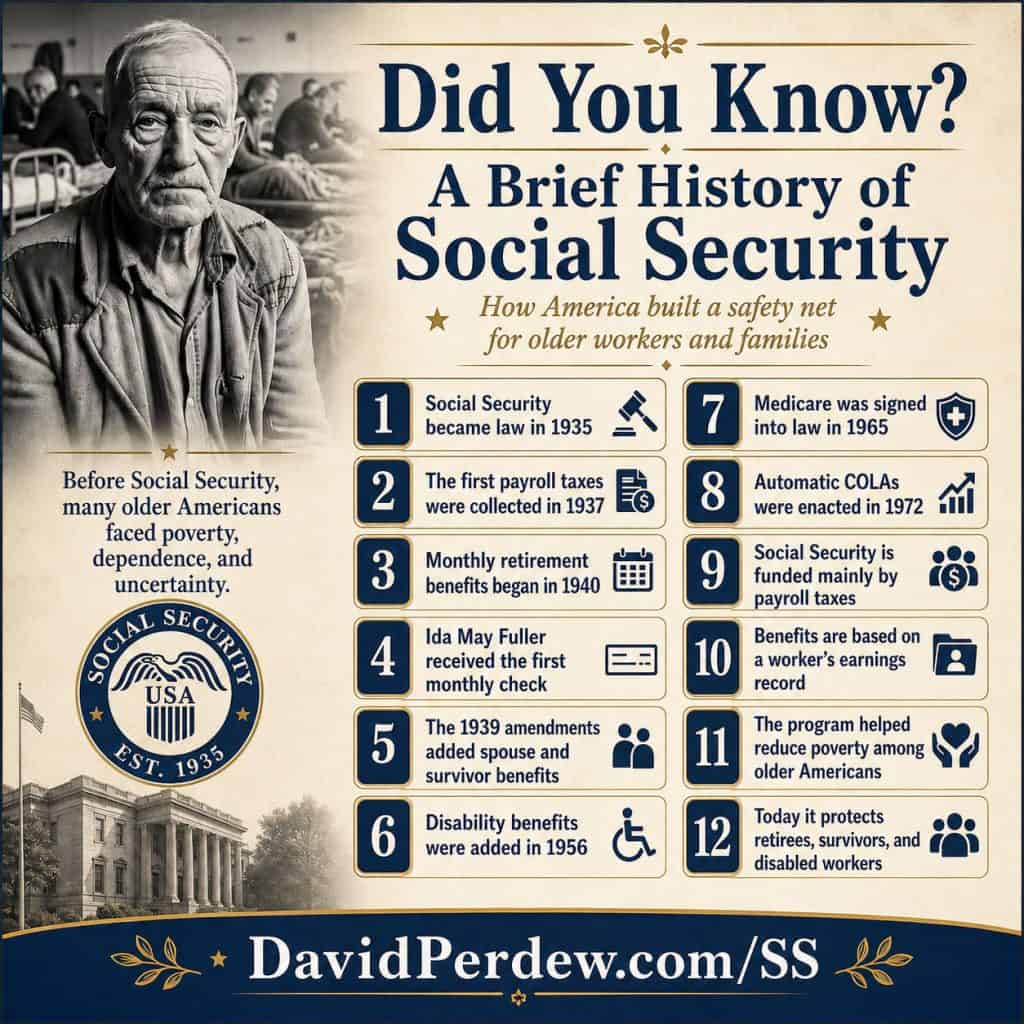
Before Social Security, retirement was not exactly a golden chapter filled with golf carts, beach sunsets, and people arguing about whether to claim at 62 or 70.
For many older Americans, retirement was not even a concept.
It was more like this: work until you cannot, hope your children can take you in, depend on charity if they cannot, and pray you do not end up in the poorhouse.
That was the retirement system.
Very efficient, if your goal was misery.
We sometimes talk about the “good old days” as if every family lived on a farm, every grandmother was cherished, every grandfather had a rocking chair by the fire, and everybody ate biscuits while singing patriotic songs.
Some families did take care of their elders. Many tried. But good intentions do not pay the doctor, buy groceries, or replace wages when an aging worker can no longer work.
Before Social Security, old age could be brutal.
The Retirement Plan Was Often “Don’t Stop Working”
Today, we debate claiming strategies.
Back then, many people had a simpler problem: they could not afford to stop.
If you were a farmer, a factory worker, a seamstress, a miner, a shop clerk, or a laborer, your income usually depended on your body. When your body started to fail, your income failed with it.
There was no guaranteed monthly benefit arriving in the mailbox.
There was no online Social Security account to check.
There was no benefit estimate at 62, full retirement age, or 70.
There was only the question: “Can I still work?”
If the answer was no, things got scary fast.
This is one reason Social Security was not some random government experiment cooked up by bored bureaucrats with too many filing cabinets. It was a response to a real problem that had become impossible to ignore.
Old age poverty was not rare. It was common enough to shape national policy.
Families Helped, Until They Couldn’t
One of the great myths about the past is that families simply took care of their older relatives and everything worked out fine.
That did happen.
It also failed a lot.
Adult children were often poor themselves. They had children of their own. They might live in crowded homes. They might be unemployed. They might be moving for work. They might barely have enough food for their own family.
So when an elderly parent needed help, the question was not always, “Do we love them?”
The question was, “How?”
How do you feed one more person when you are already short?
How do you care for an aging parent when everyone in the house has to work?
How do you provide medical care when there is no money?
How do you preserve dignity when dependence becomes permanent?
Those are not Hallmark movie questions. Those are kitchen-table questions. The kind people whisper about late at night when the bills are spread out and nobody has a good answer.
Social Security was designed to reduce that pressure.
It did not eliminate family responsibility. It created a basic floor so old age did not automatically mean begging your children for survival.
Charity Was Not a Retirement System
Before Social Security, churches, fraternal organizations, mutual aid societies, local charities, and community groups helped many people.
That help mattered.
But charity has limits.
Charity can be uneven. It can depend on where you live, who you know, whether your community has money, and whether the people in charge think you are “deserving.”
That is a lovely word, “deserving.” It has been used for centuries by people who like their compassion with a side order of judgment.
Some older people received help. Others fell through the cracks. Some communities had resources. Others did not. Some families were supported. Others were left to scramble.
A national problem needed a national answer.
That was one of the major breakthroughs of Social Security. It moved old-age income protection away from scattered charity and toward a structured national system.
Not perfect.
Not luxurious.
But predictable.
And when you are old, broke, and tired, predictable is a beautiful word.
Poorhouses Were Real
We need to talk about poorhouses because they were not fictional background scenery from a Dickens novel.
In America, poorhouses existed. Almshouses existed. County homes existed. They were places where people without financial support could be sent when there was nowhere else to go.
They housed the elderly, the disabled, the mentally ill, the unemployed, and others who had fallen into poverty. In many places, these institutions were overcrowded, underfunded, and humiliating.
Imagine working your whole life and ending up in a public institution because you outlived your wages.
That is not retirement.
That is survival with paperwork.
Social Security was created in part because this approach was morally and practically failing. A country that asked people to work, pay taxes, build families, serve communities, and contribute to national life needed a better answer than, “Try not to become a burden.”
The Great Depression Exposed the Cracks
The Great Depression did not create old-age poverty, but it ripped the curtain off it.
Savings disappeared. Jobs vanished. Banks failed. Families that had been barely holding on were pushed over the edge. Older workers had an especially hard time finding employment once they lost work.
The Depression made it obvious that individual effort alone was not enough protection against economic disaster.
That matters because Americans love the idea of self-reliance.
I like self-reliance too. It sounds strong. It looks good on a coffee mug. It makes for a fine speech.
But self-reliance has limits when the economy collapses, your job disappears, your savings evaporate, your body wears out, and nobody wants to hire an older worker.
At that point, telling people to “just work harder” is not wisdom.
It is bumper-sticker cruelty.
Social Security grew out of the recognition that some risks are too large for individuals and families to carry alone.
The 1935 Law Was a Starting Point
The Social Security Act was signed into law in 1935 by President Franklin D. Roosevelt.
It did not begin as the full program we know today.
At first, Social Security focused mainly on retirement benefits for covered workers. It was built as a contributory system, meaning workers paid in through payroll taxes and later became eligible for benefits based on their earnings record.
This design was important.
It was not simply a welfare program. It was an earned benefit tied to work.
People paid in. They built a record. They became eligible for benefits.
That structure helped Social Security gain public support because it connected benefits to contribution. Workers were not asking for charity. They were participating in a national insurance system.
There is a big difference.
Charity says, “Please help me.”
Insurance says, “This is what the system was designed to do.”
The Program Expanded Because Real Life Is Messy
The original program did not cover everything.
Real life, being rude as usual, quickly revealed that retirement was not the only risk families faced.
What happens when a worker dies and leaves behind a spouse or children?
What happens when a worker becomes disabled before retirement age?
What happens when medical costs become overwhelming in old age?
Over time, Social Security expanded.
Spousal and survivor benefits were added. Disability benefits came later. Medicare became part of the broader retirement security landscape in the 1960s. Cost-of-living adjustments eventually helped benefits respond to inflation.
Each change reflected a basic truth: financial risk does not arrive politely in one category.
It shows up as old age, death, disability, illness, inflation, lost wages, and family disruption.
Social Security became more than a retirement check because Americans needed more than a retirement check.
Ida May Fuller and the First Monthly Check
One of the best-known stories in Social Security history is Ida May Fuller, the first person to receive a monthly Social Security retirement benefit.
She received her first check in 1940.
Now, whenever someone brings up Ida May Fuller, they often use her story to make a point about how early beneficiaries received far more than they paid in.
Fine. That is true in her case.
But the larger point is not that Ida May Fuller won some magical government lottery.
The larger point is that Social Security had moved from idea to reality.
A retired worker received a monthly benefit. Not charity. Not a basket from a church committee. Not a bed in a poorhouse.
A monthly benefit.
That was a new kind of promise.
Why the History Still Matters
You cannot understand Social Security today if you do not understand what came before it.
The program was not created because Americans were lazy.
It was not created because families stopped caring.
It was not created because politicians wanted another acronym.
It was created because old age poverty was real, charity was uneven, family support was unreliable, and the economy could crush people who had worked all their lives.
Social Security created a floor.
Not a ceiling.
A floor.
It gave older Americans a measure of independence. It reduced the fear of destitution. It helped families. It protected widows, widowers, children, disabled workers, and retirees.
And it changed what aging meant in America.
The Bottom Line
Before Social Security, getting old without money could be terrifying.
That is not drama. That is history.
The system we have today grew out of hard experience. People saw what happened when old age, poverty, disability, death, and economic collapse met a society with no reliable national protection.
It was ugly.
Social Security was the answer America built.
Not a perfect answer. Not a complete retirement plan. Not a luxury program.
But a powerful floor under millions of people who might otherwise have fallen into poverty, dependence, or despair.
So the next time someone casually says, “We never needed Social Security,” ask them which part they miss most.
The poorhouses?
The charity lines?
The dependence on children who were broke too?
Or the retirement plan where you worked until your body finally resigned without notice?
History is useful that way.
It reminds us what we already tried, and why we decided not to go back.