Claiming Social Security at 62: What It Really Costs
Claiming early can make sense in some situations, but it can also lock you into a lower monthly benefit for the rest of your life.
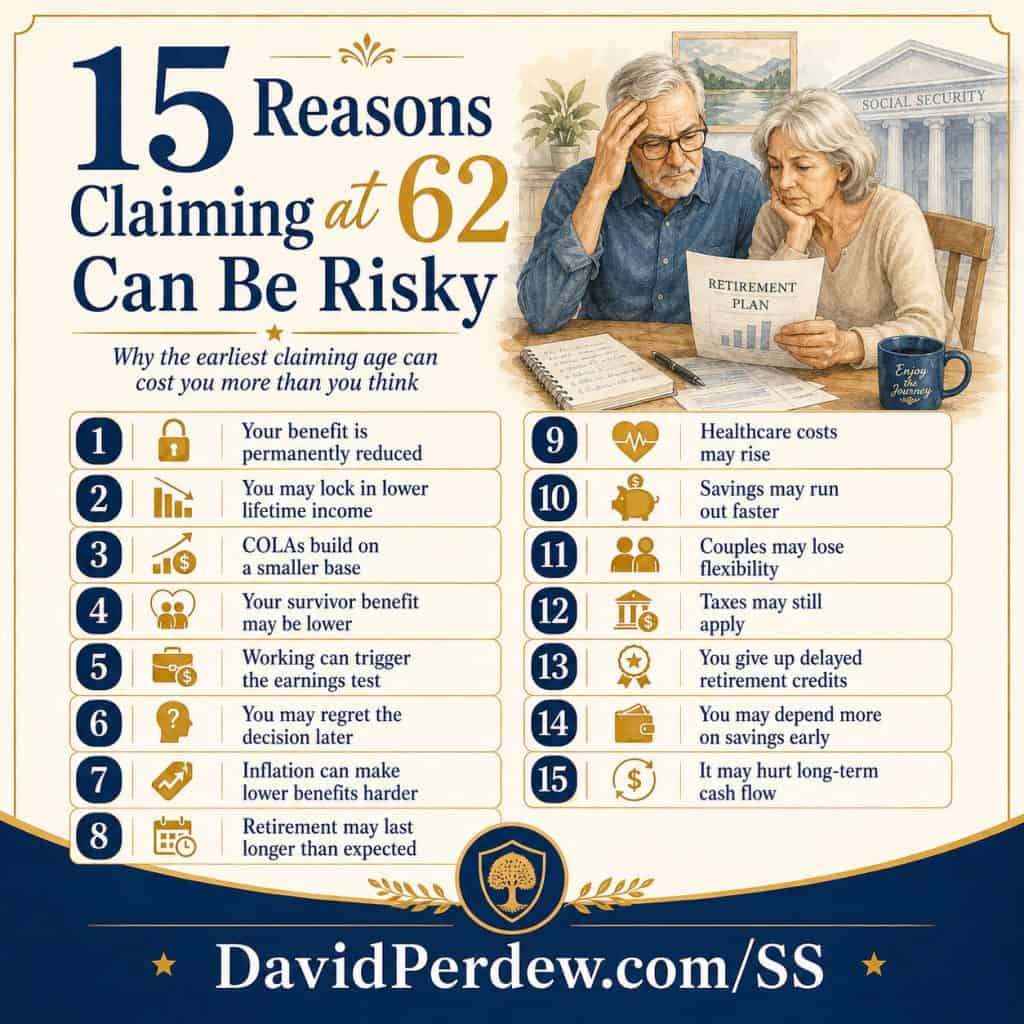
Claiming Social Security at 62 is tempting.
Of course it is.
You have worked for decades. You have paid into the system. Your knees are making noises you do not appreciate. Your boss has started using phrases like “new productivity platform.” Your inbox has become a crime scene.
And then Social Security says, “Good news, you can start taking benefits at 62.”
That sounds wonderful.
It sounds like freedom.
It sounds like walking out of work, tossing your badge in a drawer, and never attending another meeting where someone says, “Let’s circle back.”
But before you claim at 62, you need to understand what you are actually doing.
Because early claiming is not just “getting your money sooner.”
It is often accepting a permanently reduced monthly benefit.
And “permanently” is one of those words that should make you sit up a little straighter.
The Big Trade-Off
Social Security gives you a choice.
You can claim as early as 62. You can wait until your full retirement age. Or you can delay up to age 70 for a larger monthly benefit.
That sounds simple.
It is not simple, of course, because this is Social Security, and apparently every rule must come with a side dish of confusion.
But the basic trade-off is easy enough.
Claim early, and you get money sooner.
Wait longer, and you may get more money each month.
That is the deal.
The problem is that many people focus only on the “sooner” part. They forget the “smaller check for life” part.
That is like buying a cheap roof and ignoring the part where it leaks every time it rains.
Your Benefit Is Permanently Reduced
When you claim before full retirement age, your benefit is reduced.
Not temporarily.
Not until the government feels bad for you.
Not until you send a strongly worded letter.
Reduced.
That lower benefit becomes the base for your future payments. Cost-of-living adjustments may increase it over time, but they increase from a smaller starting point.
That matters.
A smaller check at 62 may not seem terrible when you are healthy, active, and still able to adjust. But what about at 78? What about 83? What about 89, when everything costs more and you are less interested in working part-time at a hardware store while pretending you enjoy helping people find mulch?
The risk is not just the first few years.
The risk is the long tail of retirement.
And retirement can last a lot longer than people expect.
COLAs Build on a Smaller Base
Cost-of-living adjustments sound like magic.
They are not.
They are helpful, but they do not erase the effect of claiming early.
If you claim a reduced benefit, future COLAs are applied to that reduced amount. So while your check may grow over time, it is growing from a smaller base.
That means the gap between an early benefit and a delayed benefit can continue to matter year after year.
Think of it this way.
If two people get the same percentage raise every year, but one starts with a smaller paycheck, that person usually stays behind.
That is not advanced math.
That is life being annoying in spreadsheet form.
You May Lock In Lower Lifetime Income
The big fear people have is, “What if I wait and die early?”
That is a fair concern.
None of us gets a calendar with the exact date circled in red. If we did, retirement planning would be much easier and also deeply unsettling.
So yes, claiming early can make sense if you have serious health issues, a shorter life expectancy, or an immediate need for income.
But the opposite risk is also real.
What if you live longer than expected?
People often underestimate how long retirement can last. Living into your 80s or 90s is not some wild fantasy. It happens every day. And if it happens to you, the size of your monthly benefit can become very important.
The longer you live, the more valuable a higher monthly check may become.
That is why the claiming decision should not be based only on the first few years. It should be based on cash flow over the rest of your life.
The Survivor Benefit Problem
Early claiming can also affect a spouse.
This is where couples need to slow down and think.
If you are the higher earner, your claiming decision may affect the survivor benefit your spouse receives after you die.
That is not exactly a cheery breakfast conversation.
“Pass the toast, and let’s discuss what happens financially after one of us is gone.”
Still, it matters.
If the surviving spouse may eventually depend on the higher benefit, then claiming early can create a smaller income stream for the survivor later.
This is one of the biggest mistakes couples make. They think about the benefit while both are alive. They do not think enough about the income the surviving spouse will need after one check disappears.
When one spouse dies, expenses usually do not fall in half.
The electric bill does not say, “Sorry for your loss, here is 50 percent off.”
Housing, taxes, insurance, food, transportation, medical costs, and maintenance may still be there.
So for married couples, claiming early is not just an individual decision. It can be a household decision with long-term consequences.
Working Can Trigger the Earnings Test
Here is another fun little wrinkle.
If you claim Social Security before full retirement age and keep working, your benefits may be reduced if your earnings exceed the annual earnings limit.
Many people discover this after the fact, which is a terrible way to learn anything involving money.
To be clear, this does not mean working while claiming is always bad. It does not mean the money is gone forever in every sense. But it does mean your monthly benefit may be withheld or reduced while you are still under full retirement age and earning above the limit.
That can surprise people who thought they would claim at 62, keep working, and enjoy a nice extra income stream.
Sometimes that works.
Sometimes it turns into “Why is my check smaller than I expected?”
And nobody wants that conversation.
Before claiming early while working, learn the rules.
“Oops, I didn’t know” is understandable.
It is also expensive.
Inflation Can Make a Smaller Benefit Hurt More Later
Inflation is sneaky.
It does not knock on the door and announce, “Good morning, I am here to make your retirement less comfortable.”
It just quietly raises the price of everything while you are busy living your life.
A smaller Social Security benefit may feel manageable in the early years. But as prices rise, medical costs increase, insurance premiums change, home repairs show up, and groceries decide they have become luxury items, that smaller benefit can feel tighter.
This is where people sometimes regret claiming early.
Not always.
But often enough to pay attention.
A bigger monthly benefit later in life can provide breathing room. It can reduce pressure on savings. It can help you avoid depending too heavily on credit cards, children, or part-time work.
And let’s be honest. “My financial plan depends on never needing a new roof, dental work, car repairs, or eyeglasses” is not a plan.
It is a dare.
Claiming Early Can Drain Savings Faster
Some people claim early to avoid using savings.
That can make sense.
But sometimes the opposite happens.
A smaller Social Security check means you may need to withdraw more from savings every month to maintain your lifestyle. Over time, that can drain savings faster than expected.
This is why you need to look at your whole retirement cash flow, not just the Social Security check.
Ask yourself:
What income will I have besides Social Security?
How much do I need each month?
Will I keep working?
How long can my savings last?
What happens if one spouse dies?
What happens if healthcare costs rise?
What happens if I live longer than expected?
These are not cheerful questions, but they are useful ones.
Retirement planning is not about pretending everything will go perfectly. It is about building a plan sturdy enough to survive normal life, which has a long history of being rude.
The Break-Even Obsession
People love the break-even point.
They want to know the exact age when waiting produces more total lifetime money than claiming early.
That is useful information.
It is not the whole story.
The break-even calculation can help compare lifetime totals. But it does not fully capture the value of higher monthly income later in life.
Cash flow matters.
A person at 82 may not care that much about winning a theoretical lifetime math contest. They may care about whether this month’s income covers the bills.
That is why claiming decisions should not be based only on “How long do I have to live to win?”
This is not a carnival game.
The better question may be, “What benefit amount gives me the best long-term security?”
When Claiming at 62 May Make Sense
Now, let’s be fair.
Claiming at 62 is not automatically wrong.
It may make sense if you truly need the income.
It may make sense if your health is poor.
It may make sense if you have a shorter life expectancy.
It may make sense if you are out of work and cannot find suitable employment.
It may make sense if you have other assets and a broader strategy.
It may make sense if you are the lower-earning spouse and your household plan supports it.
The goal is not to shame people for claiming early.
The goal is to keep people from claiming early for bad reasons.
Bad reasons include panic, rumors, pressure from friends, misunderstanding the rules, or the classic “I want to get mine before it disappears.”
That last one is common.
It is also usually not a strategy. It is fear wearing a baseball cap.
The Real Question
The real question is not, “Should everyone claim at 62?”
The real question is, “Is claiming at 62 the best decision for your life, your health, your spouse, your savings, your work plans, and your future cash flow?”
That is a different question.
A better question.
A question that might save you thousands of dollars over retirement.
Social Security is not a one-size-fits-all decision. It is personal. It depends on your numbers, not your neighbor’s opinion.
And please remember, your neighbor may be very nice and still have no idea what he is talking about.
Nice people can give terrible financial advice.
Often with confidence.
The Bottom Line
Claiming Social Security at 62 can be the right move.
But it can also be risky.
It can permanently reduce your monthly benefit. It can shrink future COLA increases. It can affect a surviving spouse. It can trigger the earnings test if you keep working before full retirement age. It can put more pressure on savings later. And it can leave you with less income if retirement lasts longer than expected.
So do not claim early just because you can.
Do not claim early just because someone scared you.
Do not claim early because you heard Social Security is vanishing.
Know your numbers.
Compare your options.
Think beyond the first check.
Because Social Security is not just about getting money as soon as possible.
It is about creating income you can live with for the rest of your life.