
Social Security Pre-Claim Checklist: What to Review First
Social Security is not a “click the button and hope for the best” decision. Before you claim, check the numbers, the rules, your spouse’s options, your work plans, and the future version of you who has to live with the result.
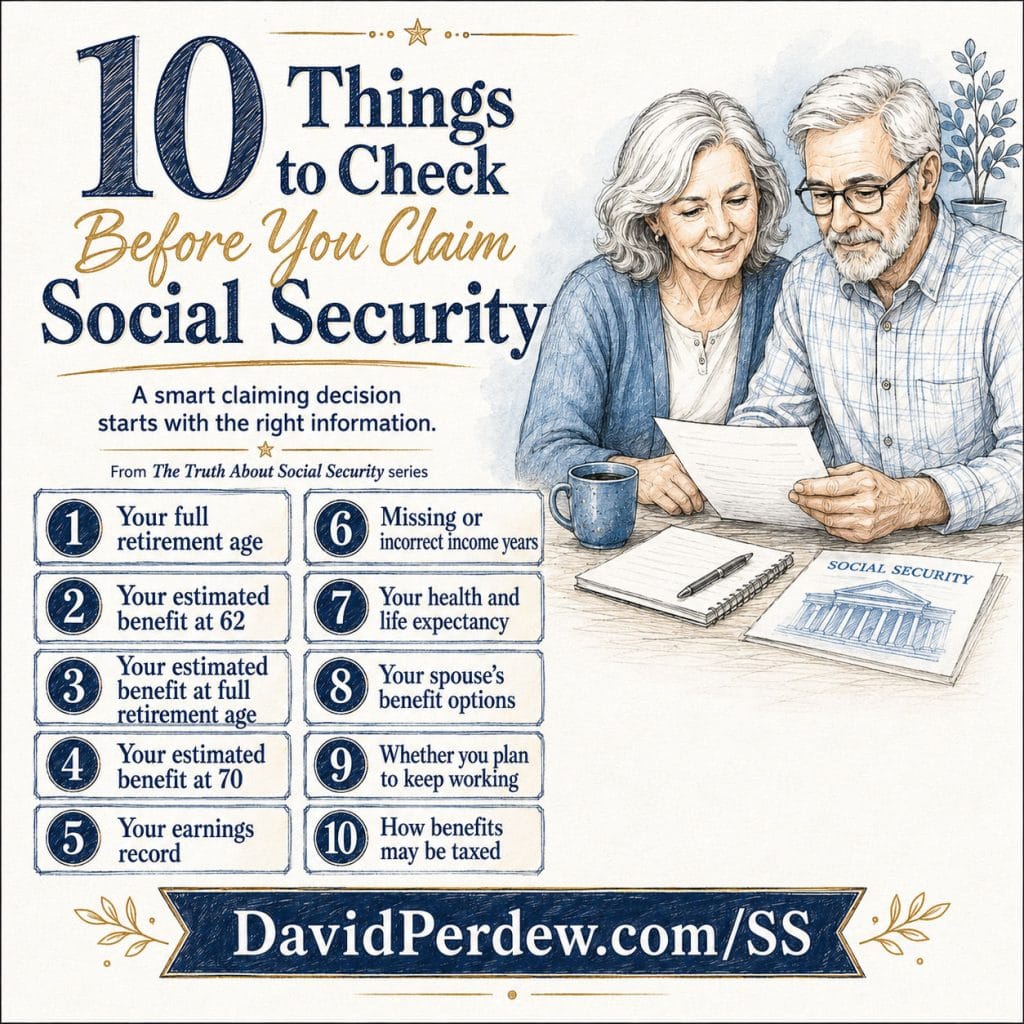
Claiming Social Security feels like it should be simple.
You worked.
You paid in.
You got older.
The government owes you a check.
End of story.
Except, of course, it is not the end of the story, because Social Security has rules, timelines, reductions, credits, earnings tests, taxes, spouse benefits, survivor benefits, Medicare overlaps, and enough fine print to make a normal person consider moving to a cabin and communicating only with squirrels.
But the decision is too important to wing it.
Your claiming age can affect your monthly income for the rest of your life. And if you are married, widowed, divorced, still working, self-employed, or relying heavily on Social Security, the stakes are even higher.
So before you file, check these things.
Not after.
Before.
“Oops” is not a great retirement strategy.
Check Your Full Retirement Age
Your full retirement age is the age when you can receive your full Social Security retirement benefit without an early-claiming reduction.
This is not the same for everyone.
For people born in 1960 or later, full retirement age is 67. For people born earlier, it may be 66 and some months.
This matters because claiming before full retirement age usually means a permanently reduced benefit. Claiming after full retirement age can increase your benefit up to age 70.
So if you do not know your full retirement age, stop right there.
You are not ready to claim.
That would be like signing a mortgage without knowing the interest rate because the pen felt nice.
Check Your Benefit at 62
Age 62 is the earliest most people can claim retirement benefits.
That makes it tempting.
Very tempting.
Social Security says, “You can start now,” and part of your brain says, “Wonderful. I have been waiting for this since the Carter administration.”
But early claiming comes with a cost.
If you claim at 62, your benefit will be reduced compared with your full retirement age amount. That reduction can be significant, especially if your full retirement age is 67.
That does not mean claiming at 62 is always wrong.
It may be right if you need the income, have serious health concerns, cannot keep working, or have a thoughtful household strategy.
But do not claim at 62 just because the door opens.
A door can open into a broom closet.
Look first.
Check Your Benefit at Full Retirement Age
Your full retirement age benefit is your baseline.
It is the number Social Security uses as the starting point for early reductions and delayed increases.
You need to know this number because it helps you compare.
If I claim at 62, how much less do I get?
If I wait until full retirement age, what do I gain?
If I wait until 70, how much more do I get?
Without this comparison, you are just choosing an age because it feels right.
Feelings are fine when picking a paint color.
They are less reliable when choosing lifelong income.
Check Your Benefit at 70
Age 70 is the latest age that increases your Social Security retirement benefit through delayed retirement credits.
That means if you wait beyond full retirement age, your monthly benefit can grow until age 70.
After 70, the increase stops.
There is no secret “super patient citizen” bonus at 71.
If you can afford to wait, the age 70 number can be powerful. It may give you a larger monthly check, better long-term cash flow, and stronger protection if you live a long time.
If you are the higher earner in a married couple, that larger check may also help protect your surviving spouse later.
So check the age 70 estimate.
You may decide not to wait.
Fine.
But at least know what you are giving up.
Check Your Earnings Record
Your Social Security benefit is based on your earnings record.
Not your memory.
Not your effort.
Not what your business “really made.”
The record.
Social Security generally calculates retirement benefits using your highest 35 years of indexed earnings. If your earnings record is wrong, your benefit estimate may be wrong too.
So review your record before you claim.
Look for missing years.
Look for earnings that seem too low.
Look for self-employment income that did not appear correctly.
Look for old employer reporting mistakes.
This is boring.
It is also important.
You know what is more boring than checking your earnings record?
Trying to fix a missing earnings year from 1997 after you have already claimed and no longer know where the paperwork is.
Check for Missing or Incorrect Income Years
Missing years can hurt.
If you have fewer than 35 years of covered earnings, zeros may be included in your benefit calculation.
Zeros are not charming.
They do not “build character.”
They lower averages.
If a year is missing because you did not work, that is one thing. If a year is missing because of an error, that is a different problem.
Do not assume Social Security has everything right.
Most records may be accurate, but mistakes happen.
Names change. Employers report incorrectly. Self-employment income gets mishandled. Social Security numbers get entered wrong. Human beings are involved, which means the possibility of error is always loitering nearby.
Check early enough that you can correct problems before they become permanent disappointments.
Check Your Health and Life Expectancy
This is not a pleasant topic, but it is a necessary one.
Your health matters when deciding when to claim.
If you have serious health problems or a shorter life expectancy, claiming earlier may make sense.
If you are in good health, have longevity in your family, and could live well into your 80s or 90s, waiting may be worth considering.
Nobody knows the exact date.
That is rude, but true.
So the best you can do is think honestly about your health, family history, current medical conditions, and ability to work.
Do not make this decision based only on fear.
Also do not make it based on denial.
“I feel fine” is not a complete retirement plan. Neither is “Everybody in my family dies early,” especially if you are ignoring the part where medical care, lifestyle, and plain luck have changed over time.
Be realistic.
Not dramatic.
Realistic.
Check Your Spouse’s Benefit Options
If you are married, your Social Security decision is not just about you.
Sorry.
Marriage does that.
Your spouse may qualify for benefits based on your record. You may qualify for benefits based on theirs. The timing of each claim can affect total household income.
This is especially important if one spouse earned much more than the other.
The lower-earning spouse may have options based on the higher earner’s record. But spousal benefits are not automatic magic. They depend on eligibility, claiming age, and the amount of each person’s own benefit.
So before either spouse claims, compare both records.
What happens if you claim now?
What happens if your spouse waits?
What happens if the higher earner delays?
What happens if the lower earner claims earlier?
These are household questions.
Treat them that way.
Check the Survivor Benefit Impact
This may be the most overlooked issue for couples.
When one spouse dies, the surviving spouse usually does not keep both Social Security checks.
One check goes away.
Many expenses remain.
The surviving spouse may be eligible for the higher benefit, depending on the situation. That means the higher earner’s claiming decision can affect the surviving spouse’s income later.
If the higher earner claims early, the survivor may be left with a smaller benefit.
If the higher earner delays, the survivor may have a larger check to rely on.
This is not fun to talk about.
Do it anyway.
Love is not just flowers, vacations, and remembering which shows you watch together.
Sometimes love is making sure the person left behind can still pay the bills.
Check Whether You Plan to Keep Working
If you claim before full retirement age and keep working, the earnings test may affect your benefits.
This is one of the rules that trips people up.
They think they can claim early, keep earning a good income, and treat Social Security like extra cash.
Sometimes that works.
Sometimes the earnings test walks into the room wearing boots.
If your earnings exceed the annual limit before full retirement age, Social Security may withhold some benefits. That does not always mean the money is gone forever in the way people think, but it can create a serious cash-flow surprise.
And cash-flow surprises in retirement are rarely adorable.
If you plan to work, check the rule before claiming.
Do not learn it when the check is smaller than expected.
Check Your Tax Situation
Yes, Social Security benefits may be taxable.
I know.
Take a moment.
Depending on your combined income, part of your benefit may be subject to federal income tax. This does not mean the government takes 85 percent of your check, despite what someone’s angry post may suggest.
It means up to 85 percent of the benefit may be included in taxable income, depending on your income.
That distinction matters.
Social Security should be considered alongside pensions, IRA withdrawals, Roth accounts, work income, investment income, and other sources.
Taxes may not determine your claiming age by themselves, but they can affect how much of your benefit you actually keep.
And the money you keep is the money that buys groceries.
The IRS does not accept “but my gross income looked fine” as payment.
Check Medicare Timing
Social Security and Medicare are connected in people’s minds, but they are not the same decision.
You can delay Social Security until 70.
That does not mean you should ignore Medicare until 70.
For most people, Medicare eligibility begins at 65. If you are not already receiving Social Security, you may need to sign up for Medicare yourself.
Missing the right Medicare timing can lead to penalties or coverage gaps, depending on your situation.
That is not the kind of surprise you want.
At 65, you should know exactly what your Medicare plan is, whether you are still covered by current employment, whether you need to enroll, and how delaying Social Security affects premium payment.
Retirement planning has many moving parts.
Medicare is one of the parts that can pinch your fingers.
Check Whether You Have Other Income
Social Security was not designed to be your entire retirement plan.
It was designed as one part of retirement income.
So before claiming, look at everything.
Do you have savings?
A pension?
IRA or 401(k) money?
Roth accounts?
Investment income?
Rental income?
Part-time work?
An annuity?
A spouse’s income?
A paid-off house?
A house payment that still thinks it is young and energetic?
Your Social Security claiming age should fit your whole income picture.
If you have enough resources to delay, that may be worth exploring.
If you do not, claiming earlier may be necessary.
There is no shame in either answer.
The mistake is deciding without looking.
Check Your Monthly Cash Flow
Do not just ask, “How much will my check be?”
Ask, “Can I live on this?”
That is a different question.
Create a simple monthly retirement budget.
Housing.
Food.
Utilities.
Insurance.
Transportation.
Medications.
Healthcare.
Debt.
Taxes.
Home repairs.
Emergency fund.
Fun money, because retirement should not be one long coupon-clipping hostage situation.
Then compare that budget with your expected income.
A claiming strategy that looks good in theory may fail if the monthly cash flow does not work.
You need a plan that survives contact with real bills.
Real bills are annoyingly persistent.
Check Whether You Are Reacting to Fear
This may be the most personal check.
Why are you claiming?
Because the numbers make sense?
Because you need the income?
Because your health requires it?
Because it fits your household strategy?
Good.
Or are you claiming because you heard Social Security is “going broke,” your friend claimed early, your cousin said the government stole the money, or a headline scared you before breakfast?
Bad.
Fear can push people into permanent decisions.
Do not let it.
Social Security has real funding challenges, but panic is not a plan.
Make your decision based on your numbers, your life, and the rules.
Not rumors.
The Bottom Line
Before you claim Social Security, check everything that matters.
Your full retirement age.
Your benefit at 62, full retirement age, and 70.
Your earnings record.
Missing income years.
Your health.
Your spouse’s options.
Survivor benefits.
Work plans.
Taxes.
Medicare timing.
Other income.
Monthly cash flow.
And the reason you are claiming in the first place.
This is not about making Social Security complicated.
It already took care of that.
This is about making your decision clearer.
A good claiming decision can improve your income for life. A rushed decision can reduce your check, limit survivor protection, and create regrets you carry into your 70s, 80s, or beyond.
So slow down.
Check the facts.
Know your numbers.
Then claim with confidence.
That beats crossing your fingers and hoping the government spreadsheet is kind.