Social Security Benefits After Divorce: What You Can Claim
If you were married long enough, your ex-spouse’s earnings record may still matter, even if the marriage ended years ago and nobody wants to discuss who got the good cookware.
Divorce is not usually described as a retirement planning event.
It is described with other words.
Painful.
Expensive.
Exhausting.
Awkward at weddings.
But for Social Security purposes, divorce can matter a lot.
Many people assume that once a marriage ends, every financial connection disappears. That may be true for some things. The house gets sold. The bank accounts get divided. The furniture goes somewhere. The dog makes a silent judgment and chooses sides.
But Social Security has its own rules.
And under those rules, a divorced person may still be eligible for benefits based on a former spouse’s record, if the marriage lasted long enough and other requirements are met.
This surprises a lot of people.
It should not.
Social Security was designed to protect families and households, and many spouses spent years supporting a household in ways that did not always show up as high earnings on their own work record.
That reality does not vanish just because the marriage ended.
The 10-Year Rule Is the Big One
The rule most people hear about is the 10-year marriage requirement.
SSA says that if you are divorced and your marriage lasted at least 10 years, you may be able to get benefits on your former spouse’s record. Your former spouse may also be able to get benefits on your record.
That “may be able” language is important.
It does not mean every divorced person automatically qualifies.
It does mean the door may still be open.
If your marriage lasted nine years and eleven months, Social Security is not likely to round up because the marriage “felt like twenty.” Feelings are powerful. Government eligibility rules are not famous for caring.
Ten years means ten years.
This is why the exact dates of marriage and divorce matter. Not the date you separated. Not the date you stopped speaking except through attorneys. The legal marriage dates matter.
Romance may be fuzzy.
Eligibility is not.
Your Ex Does Not Have to Approve
Here is a fact that brings some people great comfort.
Your ex-spouse does not have to approve your claim.
You do not need to call them.
You do not need to ask nicely.
You do not need to reopen a relationship that has been safely locked in a mental storage unit for years.
If you qualify for divorced spouse benefits, your eligibility is determined by Social Security rules, not by whether your ex feels generous that day.
That is good, because relying on an ex-spouse’s goodwill is not always what financial planners would call “stable income planning.”
And no, your ex cannot stop you from filing just because they are annoyed.
They may still be annoyed, of course.
That is their hobby.
Your Claim Does Not Reduce Their Benefit
Another important point: if you receive divorced spouse benefits on an ex-spouse’s record, it generally does not reduce the benefit paid to your ex-spouse or to their current spouse.
SSA materials explain that benefits paid to a divorced spouse do not reduce payments made to the ex or payments due to the ex’s current spouse.
This is one of the best parts of the rule because it removes a lot of emotional nonsense.
You are not taking money out of your ex’s pocket.
You are not stealing from their new spouse.
You are not creating a Social Security soap opera where everyone fights over one check.
Your benefit, if you qualify, is calculated under the program’s rules. Their benefit continues under their rules.
The government, in this rare moment of emotional wisdom, does not require everyone to gather in a conference room and relitigate the divorce.
Thank goodness.
Remarriage Can Change Things
Now we get to the part where the rules become more particular.
For divorced spouse benefits based on a living former spouse, remarriage generally ends eligibility on that former spouse’s record. SSA says that if you remarry, benefits paid to you on your former spouse’s record generally stop.
That word “generally” is doing some work, especially when survivor benefits enter the picture.
Still, the basic rule is simple enough for many cases: if you are receiving benefits as a divorced spouse and then remarry, those divorced spouse benefits on the former spouse’s record may stop.
This is not a moral judgment.
Social Security is not sitting in the corner saying, “Oh, you moved on? Interesting.”
It is just how the benefit category works.
But remarriage rules can differ depending on whether the former spouse is living or deceased, how old you are, and whether disability is involved.
So if you have remarried, are thinking about remarriage, or have a deceased former spouse, do not guess. Check the rules.
Guessing is fine when choosing soup.
Not here.
Survivor Benefits May Be Different
Divorced spouse benefits and surviving divorced spouse benefits are related, but they are not the same thing.
If your former spouse dies, you may be eligible for survivor benefits if you meet the requirements. SSA’s survivor benefit publication says a surviving divorced spouse age 60 or older, or age 50 to 59 if disabled, may qualify if the marriage lasted at least 10 years.
That can be a major issue.
Survivor benefits may be higher than divorced spouse benefits based on a living ex-spouse.
A divorced spouse benefit may be up to a portion of the former spouse’s benefit. A survivor benefit may be based more directly on the deceased worker’s benefit amount, depending on age and other rules.
This matters for retirement income.
It also matters because people sometimes assume divorce erased every possible survivor benefit.
Not necessarily.
The marriage ended.
The Social Security record did not vanish into the attic.
Remarrying After 60 Has Special Survivor Rules
Here is one of those rules that feels oddly specific because, well, it is.
SSA’s handbook says remarriage after age 60 does not prevent a widow, widower, or surviving divorced spouse from becoming entitled to benefits on a prior deceased spouse’s Social Security earnings record. For a disabled widow, widower, or surviving divorced spouse, remarriage after age 50 may not prevent entitlement if the disability rules are met.
That is a mouthful.
The plain-English version is this: remarriage can affect benefits, but survivor benefits have special rules, especially after age 60.
This is one reason older adults should not make remarriage decisions without understanding the benefit consequences.
I am not suggesting that romance should be decided by a spreadsheet.
That would be bleak.
But if marriage may change your monthly income, it is worth knowing before you order the cake.
Love is wonderful.
So is avoiding preventable financial surprises.
Your Own Benefit Is Compared First
If you are eligible for benefits based on your own work record and also potentially eligible based on a former spouse’s record, Social Security does not usually stack them on top of each other like retirement pancakes.
It generally pays your own benefit first. If the divorced spouse benefit amount is higher, you may receive an additional amount to bring you up toward the higher total.
This distinction matters because people sometimes think, “I’ll get mine plus part of theirs.”
Usually, no.
Social Security is not that generous.
It looks at the benefit categories and applies the rules. The divorced spouse amount may help if it is larger than your own benefit, but it is not normally a bonus check added on top.
That is disappointing, I know.
A lot of retirement planning would be easier if the answer were “both.”
Timing Still Matters
Divorced spouse benefits are still affected by age and timing.
You generally need to be at least 62 to apply for divorced spouse benefits based on a living former spouse. SSA’s application page says you can apply for spouse’s or divorced spouse’s benefits online if you are within three months of age 62 or older.
Claiming before full retirement age can reduce benefits.
That means the same basic claiming caution applies: do not rush without understanding the reduction.
If you claim early because you need the money, that may be the right decision.
But claiming early because you did not know the benefit could be reduced is a different story.
That is not a strategy.
That is a surprise wearing a nametag.
Documentation Matters
When applying for divorced spouse benefits, you may need documentation.
This may include proof of marriage, proof of divorce, dates, and identifying information. SSA’s spouse and divorced spouse benefit application page lists information applicants should be ready to provide.
This is another reason to keep important records.
Marriage certificate.
Divorce decree.
Dates.
Former spouse’s information if available.
I know nobody enjoys filing paperwork from a former marriage. There are probably people who would rather organize a garage full of mystery extension cords.
But records matter.
If you may qualify for a benefit, you want the proof ready.
And if you do not have it, start figuring out how to get it before you are in the middle of an application.
Retirement planning is much less stressful when it does not involve hunting documents at the last minute while muttering, “I know I put it somewhere.”
Divorce Decrees Cannot Waive Social Security Rights
This one is important.
Some divorce agreements include language where one person supposedly gives up rights to the other person’s Social Security.
For Social Security purposes, that kind of clause generally does not control federal benefit eligibility.
SSA materials explain that clauses in divorce decrees relinquishing rights to Social Security benefits on an ex-spouse’s record are not enforced if the person otherwise qualifies.
That may surprise people who remember signing something years ago.
Social Security benefits are governed by federal law.
Your divorce decree can divide property, address alimony, handle debts, and sort out many painful financial details. But it does not get to rewrite Social Security eligibility rules.
So if you think you signed away your right to divorced spouse benefits, do not assume that ends the discussion.
Check with SSA.
This is one of those cases where the federal rule may be better than your memory of the divorce paperwork.
Your Former Spouse’s Marital Status Does Not Usually Matter to You
People often ask whether it matters if the ex-spouse remarried.
In many cases, no.
Your ex’s remarriage does not automatically prevent you from qualifying for divorced spouse benefits if you meet the requirements. And your benefit generally does not reduce the ex’s benefit or the current spouse’s benefit.
This is another place where people import emotional logic into a rule-based system.
They think, “He remarried, so I must be out.”
Or, “She has a new spouse, so there is nothing there for me.”
Not necessarily.
Social Security does not operate like a family dinner seating chart.
It has eligibility categories.
If you qualify, the current spouse’s existence does not erase your history.
Do Not Assume SSA Will Volunteer Every Option
Social Security representatives can be helpful, but you should not rely entirely on someone else to identify every possible strategy.
Know enough to ask.
Ask whether you qualify on your own record.
Ask whether you qualify on a former spouse’s record.
Ask whether survivor benefits could apply.
Ask how remarriage affects your situation.
Ask whether claiming now would reduce the amount.
Ask what documentation you need.
This is especially true if you have a complicated marital history.
Multiple marriages.
Divorce.
Remarriage.
Widowhood.
Disability.
Children.
Different ages.
At that point, you do not need gossip. You need rules.
And probably coffee.
The Bottom Line
Divorce does not automatically erase your Social Security options.
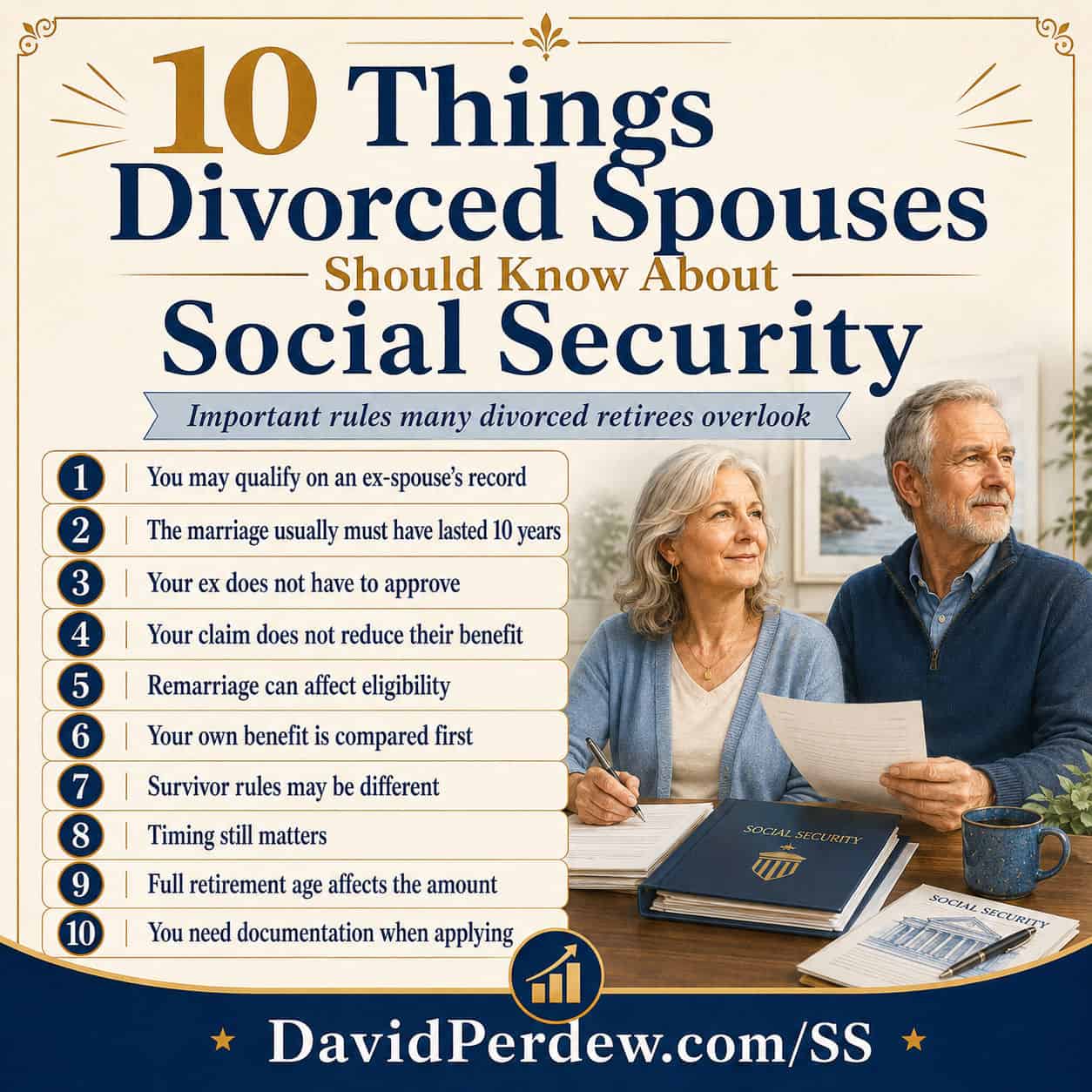
If your marriage lasted at least 10 years, you may be able to claim benefits on a former spouse’s record. Your ex does not have to approve. Your claim generally does not reduce their benefit or their current spouse’s benefit. Remarriage can affect divorced spouse benefits, but survivor benefit rules can be different, especially after age 60. Your own benefit is usually considered first. Timing matters. Documentation matters.
The biggest mistake is assuming there is nothing to check.
There may be.
And that check could matter for the rest of your life.
So do not let old pain, bad memories, or a dusty divorce decree keep you from understanding the rules.
This is not about reopening the past.
It is about protecting your future.