Self-Employed and Social Security: A Costly Mistake to Avoid
If you work for yourself, the way you report income today can affect the Social Security benefit you receive later, and that little detail deserves more than a shrug.
Self-employed people are a special breed.
They are brave, stubborn, creative, overworked, under-caffeinated, and occasionally guilty of pretending that “flexible schedule” means something other than “working at 9:47 p.m. because a client just remembered a deadline.”
If you have ever worked for yourself, you know the drill.
You make the sale. You do the work. You send the invoice. You wait. You follow up. You wait again. Then, when the money finally comes in, taxes appear like raccoons in the attic.
Nobody enjoys that part.
So naturally, self-employed people try to reduce taxes where they legally can. That is not wrong. That is called breathing.
But here is the problem.
Some tax-saving strategies can quietly reduce the earnings that count toward Social Security. And when that happens year after year, the future benefit may be smaller than expected.
In plain English, you may save money today while accidentally robbing your retired self tomorrow.
And retired you will not be amused.
Social Security Only Knows What Gets Reported
Social Security does not base your benefit on how hard you worked.
It does not know how many weekends you lost, how many clients paid late, how many Zoom calls should have been emails, or how many times you said, “I should really hire help,” while continuing to do everything yourself.
Social Security uses your earnings record.
For self-employed people, that record comes from what you report for Social Security purposes. SSA says that if you have net earnings from self-employment of $400 or more in a year, you must file Form 1040, the appropriate business schedule such as Schedule C or Schedule F, and Schedule SE. Even if you do not owe income tax, you must file Schedule SE to pay self-employment Social Security tax.
That is the key.
If the income is not properly reported as covered earnings, it may not help your future Social Security benefit.
The government is not sitting there saying, “Well, Dave clearly had a good business year. Let’s give him emotional credit.”
Nope.
It uses the record.
Schedule SE Is Not Just More Tax Paperwork
Schedule SE is where self-employed people calculate Social Security and Medicare taxes on self-employment income.
The IRS says Schedule SE is used to figure the tax due on net earnings from self-employment, and the Social Security Administration uses the information from Schedule SE to figure benefits under the Social Security program.
That sentence should get your attention.
Schedule SE is not just another form in the annual tax-season parade of misery.
It helps build the record that later helps determine your benefits.
So when people say, “I don’t want to pay self-employment tax,” I understand.
Really, I do.
Self-employment tax feels like being both the employee and the employer, because that is basically what it is. When you work for someone else, you pay part and your employer pays part. When you work for yourself, congratulations, you get to be both people.
It is a beautiful system, if your hobby is sighing.
But those taxes also build your Social Security record.
That does not make paying them delightful.
It does make them meaningful.
Paying Yourself Too Little Can Backfire
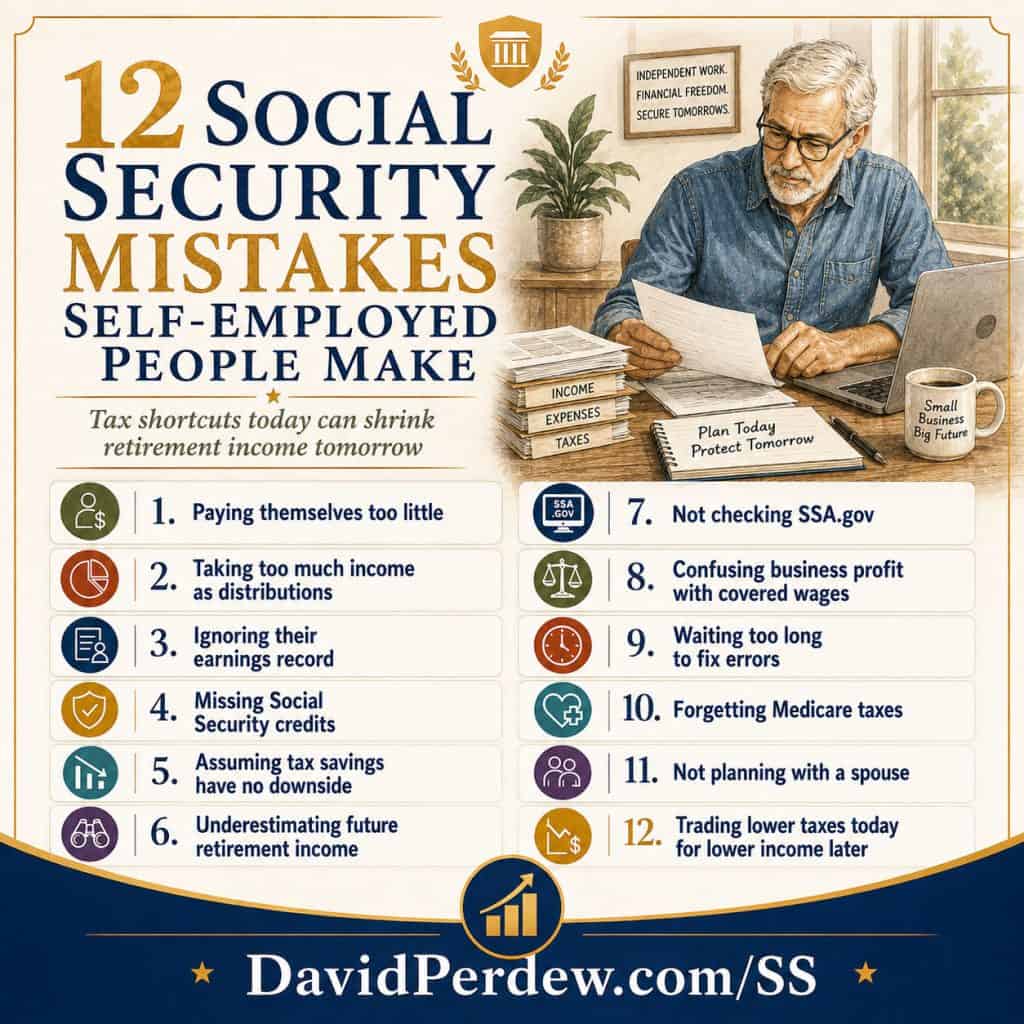
One common mistake self-employed people make is paying themselves too little.
This is especially true for small business owners who operate through certain business structures and try to minimize wages.
Now, let me be clear.
This is not tax advice. This is not legal advice. This is not “go pay yourself a huge salary and tell your CPA that a book guy on the internet said it was fine.”
No.
Talk to your tax professional.
But understand the Social Security issue.
Your future benefit is based on covered earnings. If you keep your reported covered earnings low, your future Social Security benefit may be lower too.
That may be fine if you have a large investment portfolio, rental income, a pension, or other reliable retirement income.
But if Social Security is going to matter in your retirement, and for most people it will, then treating covered earnings as something to minimize at all costs may be shortsighted.
Saving money today is wonderful.
Saving money today by shrinking tomorrow’s monthly income may be less wonderful.
That is the part people miss.
Distributions Are Not the Same as Wages
Business owners sometimes take part of their income as distributions.
Depending on your business structure, that may be legitimate and useful.
But do not confuse business income with Social Security-covered wages.
Those are not always the same thing.
If your business produces income but much of it is not reported as covered earnings for Social Security purposes, your earnings record may look weaker than your actual lifestyle suggests.
This can be a nasty surprise later.
You might think, “I built a solid business.”
Social Security might say, “Interesting. Your covered earnings record says otherwise.”
And Social Security does not accept “but I was really successful” as a calculation method.
It likes numbers.
Specific numbers.
Reported numbers.
Ignoring Your Earnings Record Is a Terrible Hobby
Self-employed people should check their Social Security earnings record regularly.
Not once.
Not when you are already 67 and holding a cup of coffee with a trembling hand.
Regularly.
SSA says you can use your personal my Social Security account to access your Statement, verify reported earnings, and estimate future benefits.
This is one of those boring tasks that can save you real money.
Look at each year. Does it match what you expected? Are any years missing? Are the numbers oddly low? Did your self-employment income show up properly?
If something is wrong, you want to know while you still have records, tax returns, forms, and a chance to fix it.
Waiting 20 years to discover a problem is not ideal.
That is like noticing the roof leak after the living room has become an indoor pond.
Missing Credits Can Hurt Eligibility
Your Social Security retirement benefit is not just about how much you may receive.
You also need enough work credits to qualify.
Most people need 40 credits to qualify for retirement benefits, and workers can earn up to four credits per year. The amount of earnings required for a credit can change each year, so this is another reason to verify your own record and not rely on what your uncle remembers from 1998.
For many workers, 40 credits means about 10 years of covered work.
But do not confuse eligibility with a strong benefit.
Getting enough credits may get you through the front door. The size of your benefit depends on your earnings history.
A self-employed person can technically qualify and still have a disappointing benefit if the earnings record is weak.
That is not the kind of surprise anyone wants at retirement.
Underestimating Future Retirement Income Is Easy
Entrepreneurs are optimistic.
They almost have to be.
No one starts a business by saying, “This will probably be exhausting and uncertain, and I hope to break even emotionally.”
Business owners tend to think things will improve.
Next year will be better.
The next product will sell.
The next launch will work.
The next client will pay faster.
The next version of the website will finally fix everything, because apparently the button color was the problem all along.
That optimism is useful when building a business.
It can be dangerous when planning retirement.
Self-employed people often assume they will sell the business, work forever, keep consulting, or live off future profits. Maybe they will. Maybe they will not.
Health changes. Markets change. Technology changes. Energy changes. Clients disappear. Industries shift. Bodies object.
Social Security may become more important than expected.
So it is worth knowing whether your current reporting choices are building a decent future benefit or quietly creating a problem.
Tax Savings Have a Downside When They Reduce Covered Earnings
Let’s say you find legal ways to reduce taxable income.
Good.
But every strategy deserves a second question: what does this do to my Social Security record?
Not every deduction hurts your Social Security. Not every business decision reduces covered earnings. This is why you need a good tax professional.
But the general principle is simple.
If your reported Social Security-covered earnings are lower, your future benefit may be lower.
That trade-off might be worth it.
It might not.
The mistake is pretending there is no trade-off.
There is almost always a trade-off hiding somewhere in the bushes.
Medicare Taxes Still Matter
Self-employment tax includes Social Security and Medicare taxes.
People often focus on the Social Security part because retirement benefits get most of the attention. But Medicare taxes are part of the same self-employment tax structure.
The IRS explains that self-employment tax covers Social Security and Medicare taxes, and self-employed sole proprietors or independent contractors generally use Schedule C to figure net earnings and Schedule SE to figure self-employment tax.
Again, this is not just busywork.
It is part of the system that connects your working years to future benefits and coverage.
Nobody is saying you should enjoy it.
Just understand it.
Couples Should Plan Together
Self-employed people who are married need to look at the household picture.
Maybe one spouse has a strong W-2 earnings record.
Maybe the other spouse has low reported self-employment earnings.
Maybe spousal benefits will matter.
Maybe survivor benefits will matter.
Maybe the higher earner should delay claiming to protect the surviving spouse.
Maybe the self-employed spouse needs to improve their own record.
The point is that the business owner’s Social Security record does not exist in isolation. It affects the couple’s retirement income plan.
Too many couples talk about business taxes with the CPA and Social Security benefits later, as if these are unrelated planets.
They are connected.
Not perfectly.
Not simply.
But connected.
Do Not Wait Too Long to Fix Errors
If your earnings record is wrong, fixing it may require documentation.
That could include tax returns, W-2s, self-employment records, or other proof. SSA provides information on correcting an earnings record and encourages people to review their online Statement, which shows estimates for retirement, disability, and survivor benefits and the earnings record behind those estimates.
The older the error, the harder it may be to reconstruct what happened.
This is why annual review matters.
It is not exciting.
It is not glamorous.
But neither is discovering a missing earnings year after the records are gone and your former accountant retired to a lake somewhere and no longer answers email.
Ask Better Questions
Self-employed people should ask better Social Security questions.
Not just, “How do I reduce taxes this year?”
Also ask:
How much income is being reported for Social Security purposes?
How does my earnings record look?
Am I earning enough credits?
What will my projected benefit be?
Would higher reported earnings improve my future benefit?
How does my business structure affect my Social Security record?
How does this affect my spouse?
Do I have enough other retirement income if my Social Security benefit is small?
These are not questions you ask after retirement.
These are questions you ask while you still have time to adjust.
The Bottom Line
Self-employed people have more control than most workers.
That is a blessing.
It is also a trap.
You may have more control over how income flows through your business, how you report earnings, and how you plan taxes. But those choices can affect your future Social Security benefit.
If you report very low covered earnings for years, your benefit may reflect that.
If you ignore your earnings record, errors may go unnoticed.
If you focus only on tax savings today, you may accidentally weaken retirement income later.
The answer is not to panic.
The answer is to pay attention.
Check your earnings record. Understand Schedule SE. Talk with a qualified tax professional. Know how your business structure affects covered earnings. Think about your spouse and survivor benefits. Look at your future benefit estimate before it becomes your current reality.
Self-employment already comes with enough surprises.
Your Social Security check should not be one of them.