Social Security Strategy for Married Couples
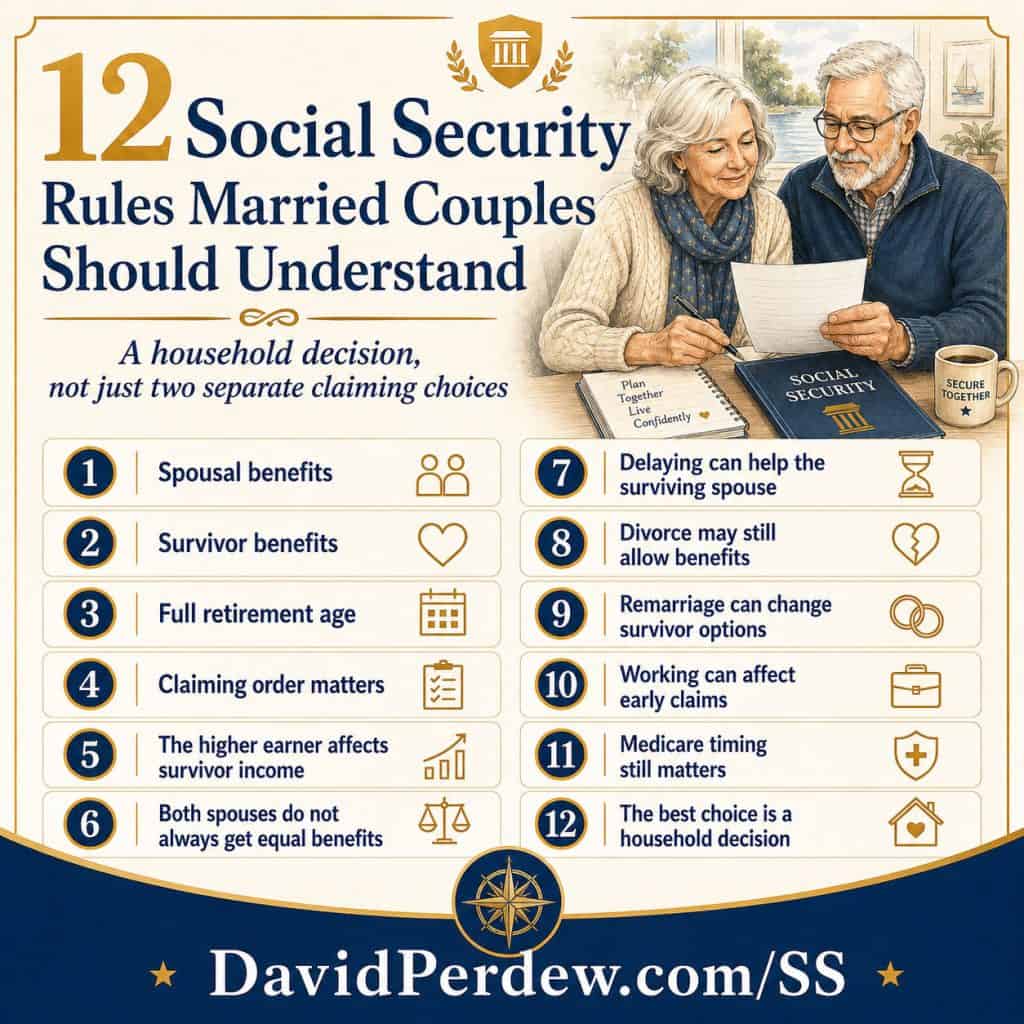
Spousal and survivor benefits can turn Social Security into a household strategy, not just a personal claiming choice.
Most married couples make hundreds of financial decisions together.
They buy houses together. They plan vacations together. They argue about whether the thermostat should be set at 68 or “why are we trying to air-condition the driveway?” They discuss cars, insurance, groceries, medical bills, grandchildren, and whether one more streaming service will finally destroy civilization.
But when it comes to Social Security, many couples suddenly act like they are two unrelated people standing in separate lines at the DMV.
“I’ll claim mine.”
“You claim yours.”
“Good luck to us both.”
That may be simple, but simple is not always smart.
Social Security for married couples is not just about two individual checks. It can involve spousal benefits, survivor benefits, claiming ages, earnings records, health, life expectancy, taxes, and future household income after one spouse dies.
That is a lot.
Which means this is not the place for guesswork, rumors, or advice from your brother-in-law who once read half an article and now speaks with the confidence of a retired actuary.
Your Claiming Decision May Affect Your Spouse
The first thing married couples need to understand is that Social Security is often a household decision.
That is especially true when one spouse earned significantly more than the other.
If both spouses have similar earnings histories, the strategy may be fairly straightforward. Each spouse looks at their own benefit options and decides when claiming makes sense.
But if one spouse has a much larger benefit, the timing of that larger benefit can matter for both people.
Why?
Because the higher earner’s benefit may later affect the survivor benefit.
That means a decision that looks personal today may become very important to the surviving spouse later.
And let’s be honest. Nobody enjoys planning around death. It is not exactly a festive Saturday morning topic.
“Would you like pancakes?”
“Yes, and then let’s discuss widowhood income.”
Still, avoiding the topic does not make the math go away.
Spousal Benefits Are Not Automatic Magic
One of the biggest myths is that a spouse automatically gets half of the other spouse’s benefit.
Not exactly.
SSA says a spousal benefit can be as much as half of the worker’s primary insurance amount, depending on the spouse’s age at retirement. If the spouse claims before full retirement age, the spousal benefit can be reduced. If the spouse’s own retirement benefit is higher, SSA generally pays that higher retirement benefit instead.
That means “half” is not a universal guarantee.
It is a maximum under certain conditions.
This is where people get into trouble. They hear one rule, slice off the details, and turn it into kitchen-table wisdom.
“My wife gets half of mine.”
Maybe.
Maybe not.
It depends on her own benefit, her age when she claims, your benefit, and whether the rules apply the way you think they do.
Social Security has a remarkable talent for making simple-sounding rules develop tentacles.
Your Own Benefit Is Usually Considered First
Here is another part that surprises people.
If a spouse is eligible for a retirement benefit based on their own work record and also eligible for a spousal benefit, Social Security generally pays the person’s own benefit first. If the spousal amount is higher, the person may receive an additional amount to bring the total up toward the spousal level.
In normal human language, that means you do not usually get your own full benefit plus half of your spouse’s benefit stacked on top like a retirement sandwich.
I wish.
That would be fun.
But no.
The system compares benefits and pays based on the rules. The spousal benefit is more like a supplement than a bonus prize.
This matters because couples sometimes plan around an amount that is not realistic.
If your retirement plan depends on receiving two checks that Social Security was never going to pay that way, the problem is not Social Security.
The problem is the plan.
Claiming Early Can Reduce Spousal Benefits
Claiming age matters.
A spouse can claim as early as age 62, but claiming before full retirement age can reduce the spousal benefit. SSA explains that spouse’s benefits may be reduced when started before full retirement age.
This is where couples need to be careful.
One spouse may be eager to claim early because the money would help now. That may be a reasonable choice. But it should be made with eyes open.
How much will the benefit be reduced?
How long is retirement likely to last?
Is one spouse still working?
Will taxes matter?
Will the household need a larger benefit later?
The early claiming decision should not be made just because the money is available.
A vending machine also makes snacks available. That does not mean the powdered donuts are a long-term nutrition plan.
Survivor Benefits Are the Big One
For married couples, survivor benefits may be the most important part of the conversation.
When one spouse dies, the surviving spouse may be eligible for survivor benefits based on the deceased spouse’s record. SSA explains that survivor benefits provide monthly payments to eligible family members of people who worked and paid Social Security taxes before they died.
A surviving spouse at full retirement age or older can generally receive 100 percent of the worker’s basic benefit amount, while a surviving spouse claiming earlier may receive a reduced percentage.
This is why the higher earner’s claiming age matters so much.
If the higher earner claims early and locks in a reduced benefit, that may limit what the surviving spouse can receive later.
If the higher earner delays and increases the benefit, that larger benefit may help protect the surviving spouse.
That is not a small detail.
That is the kind of detail that may decide whether the surviving spouse has breathing room or has to start making painful cuts.
One Check Usually Goes Away
This is the moment couples need to face clearly.
When one spouse dies, the household does not usually keep both Social Security checks.
The surviving spouse may receive the higher benefit, depending on the situation, but one income stream generally disappears.
Expenses, however, are rude.
They do not disappear at the same rate.
The mortgage or rent may stay the same. Property taxes stay. Home insurance stays. Utilities may drop a little, but not enough to throw a parade. Car expenses may change, but medical costs may rise. Food may drop, but not by half. Repairs still happen because roofs have no respect for grief.
So if a couple has been living on two Social Security checks, the surviving spouse may face a major income drop.
That is why the survivor benefit should be part of the claiming decision from the beginning.
Not later.
Not when it is too late.
From the beginning.
The Higher Earner Has a Special Responsibility
This may sound blunt, but the higher earner’s claiming decision often carries extra weight.
If one spouse earned substantially more, delaying that higher benefit can sometimes act like a form of survivor protection.
Not always.
But often enough to examine seriously.
This is especially true when the higher earner is older, has a shorter life expectancy, or has a spouse who may live many years after them.
The question is not only, “How much do I want now?”
The question is, “What happens to my spouse’s income if I die first?”
That is not gloomy. That is responsible.
Good planning is often just love with a calculator.
Not romantic, perhaps.
But extremely useful.
Divorce and Remarriage Can Change the Picture
Married couples should also understand that marital history matters.
Divorced spouses may qualify for benefits on an ex-spouse’s record if certain conditions are met. Widows, widowers, surviving divorced spouses, and remarried people may face different rules depending on age and circumstances.
This is where the details really matter.
If you have been divorced, remarried, widowed, or married more than once, do not rely on general advice. Your situation may be different.
Social Security rules are not offended by complicated family histories. They have rules for them.
But you need to know which rules apply.
And no, “I heard from a friend” does not count as research.
Working Can Affect Early Benefits
If either spouse claims before full retirement age and keeps working, the earnings test may matter.
That can affect retirement benefits, spousal benefits, and survivor benefits depending on the situation. SSA provides earnings test calculators because, apparently, even the government knows this gets complicated.
The key point is simple enough.
If you claim early and continue working, make sure you understand whether your earnings may temporarily reduce your benefits.
This is especially important for couples who are trying to coordinate one spouse’s work income with another spouse’s Social Security benefit.
You do not want to build a plan around a benefit amount and then discover the earnings test has other ideas.
The earnings test is like that one relative who shows up late and changes the seating arrangement.
Medicare Timing Still Matters
Social Security claiming and Medicare enrollment are related, but they are not the same decision.
You may delay Social Security until 70, but Medicare generally needs attention around 65 unless you have qualifying coverage through current employment or another valid reason to delay.
Couples sometimes make the mistake of treating retirement, Social Security, and Medicare as one giant decision.
They are connected.
They are not identical.
You can delay one and still need to act on another.
This is why couples should map out the timeline together.
Age 62.
Age 65.
Full retirement age.
Age 70.
Spousal options.
Survivor protection.
Work plans.
Taxes.
Healthcare.
That is a lot of moving pieces, but it is manageable when you write it down.
Trying to keep it all in your head is how people end up saying things like, “I think Medicare starts when my neighbor’s dog turns seven.”
The Best Choice Is a Household Choice
The best Social Security decision for married couples is rarely made by looking at one person’s benefit in isolation.
You need to look at the household.
What are both benefits at 62, full retirement age, and 70?
Who is the higher earner?
Who is likely to live longer?
Does either spouse have health issues?
How much savings do you have?
Will either spouse keep working?
What happens when one spouse dies?
Will taxes affect your combined income?
Do you need income now, or can you delay?
These questions may not be thrilling, but they are powerful.
And they are much better than asking, “What did Bob at church do?”
Bob may be wonderful.
Bob may also have a completely different earnings record, health situation, pension, spouse, tax picture, and retirement plan.
Do not borrow Bob’s Social Security strategy unless you also get Bob’s entire financial life.
The Bottom Line
Married couples need to treat Social Security as a joint planning decision.
Spousal benefits are not automatic magic. Survivor benefits may be the most important long-term protection. Claiming early can reduce income. The higher earner’s choice can affect the surviving spouse. One check usually disappears when one spouse dies, while many expenses remain.
This is not about fear.
It is about planning with your eyes open.
Social Security can provide powerful protection for married couples, but only if you understand how the pieces fit together.
So sit down together.
Look at both earnings records.
Compare benefit amounts.
Talk about health, savings, work, taxes, and survivor income.
Yes, it may feel uncomfortable.
Do it anyway.
Because the best claiming decision is not always the one that gives you the most money next month.
Sometimes it is the one who protects the person sitting across the table from you.